Most school searches in Suratgarh begin the same way. A parent asks two or three neighbours, collects three different opinions, then spends a week comparing fee slips and a handful of online reviews that say very little. The decision deserves better than that, because a child admitted in Class 1 will probably spend the next ten years in the same building, with the same teachers, following the same academic culture.
The questions that actually settle the matter are rarely the ones printed on a brochure. Will the bus reach our colony at a sensible hour? Is the English medium label real, or does the teaching quietly shift to Hindi the moment a concept gets difficult? How many children sit in one classroom? And when the child reaches Class 9, will the teachers handle board preparation without turning the year into a coaching factory?
This guide covers what to look for in a CBSE school in Suratgarh for Class 1 to 10, and what those ten years look like at Blossom Academy.
What separates a good CBSE school from an average one
CBSE affiliation tells you which syllabus a school follows and which board exam a child sits for in Class 10. It does not tell you how the school teaches. Two schools can run identical NCERT books and produce very different children.
The real difference shows up in how a school treats the three stages of schooling.
In the foundation years, Class 1 to 5, the job is narrow and important: reading fluency, number sense, clear handwriting, and the confidence to speak in front of others. A school that pushes heavy syllabus and long homework at this age usually produces children who are busy but not fluent.
The middle years, Class 6 to 8, are where most academic problems begin. Mathematics moves from arithmetic to algebra, science splits into three distinct disciplines, and the gap between a child who understands and a child who copies becomes hard to see from the outside. A good school catches those gaps here rather than in Class 10.
By Class 9 and 10, the syllabus depth increases sharply and internal assessment starts counting towards the final result. What matters now is structured revision, regular writing practice in board format, and teachers who have taken students through the exam enough times to know where marks are lost.
Two practical things are worth checking at any school: how many students share one teacher, and how long the teachers have been there. Frequent teacher changes disrupt a child more than most parents expect.
A year at Blossom Academy, section by section
Blossom Academy has been running in Suratgarh since 2004 and follows the CBSE curriculum in English medium from LKG to Class 10. Younger children attend the pre-primary campus in the city, while Class 1 onwards is taught at the main campus on Anupgarh Road, Manaksar, near the bus stand. The academic session begins in April, in line with the CBSE calendar.
Primary section, Class 1 to 5
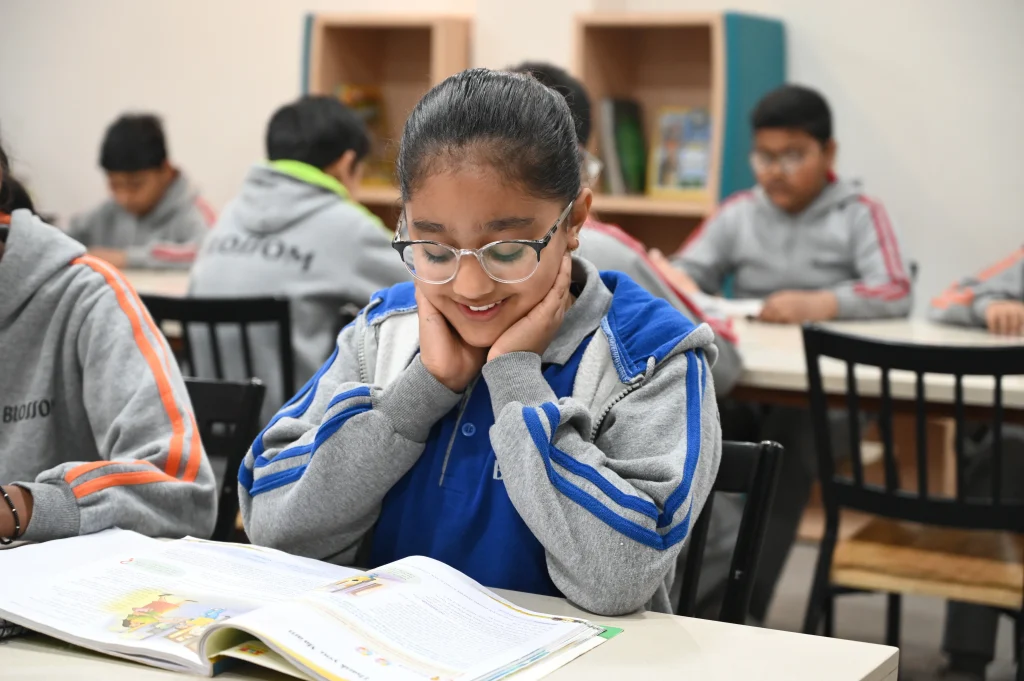
The primary day starts with assembly and moves through subject periods broken up by activity and library time. Class strength is kept close to a 1:25 teacher to student ratio, which is what allows a teacher to notice the child who has stopped following the lesson.
Reading, spoken English, and basic number work carry the most weight in these years. Weekly Blossom Speaks sessions, the school’s public speaking programme, begin from LKG itself with storytelling and short presentations in front of the class. For children from Hindi-speaking homes, which is most of Suratgarh, that early speaking practice matters more than any textbook.
Middle section, Class 6 to 8
From Class 6, students move into subject specialisation and start using the science and computer labs regularly. Assessment follows the standard CBSE pattern of periodic tests, half-yearly and annual examinations, along with internal assessment.
This is also the stage where activity choices widen. Inter-class debates, quizzes, art and craft, music, dance, and club activities such as the library club and environment club become a fixed part of the week rather than an occasional event. Parent teacher meetings are held through the year, which is the practical point at which most gaps get flagged and fixed.
Secondary section, Class 9 and 10
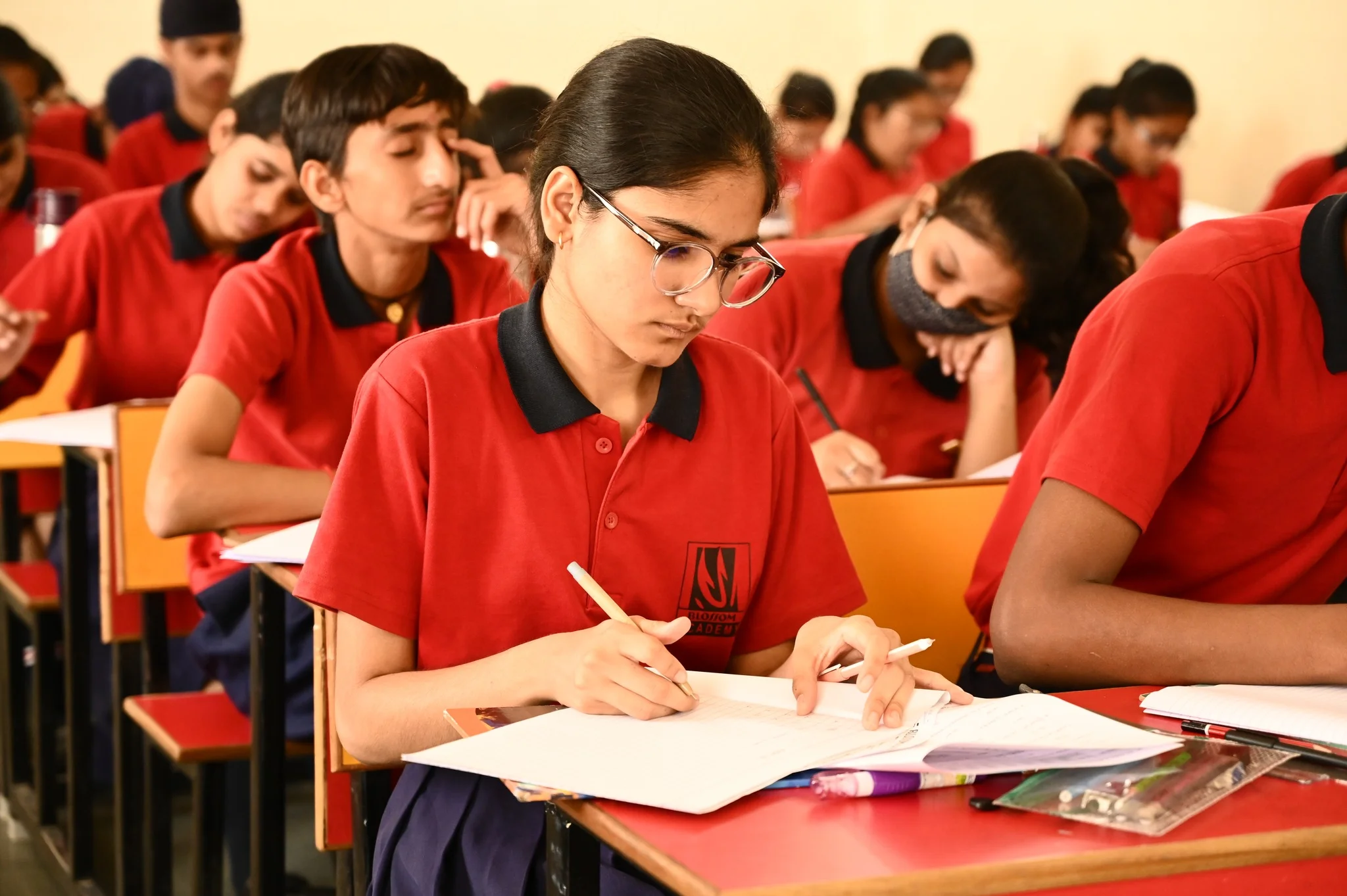
Class 9 and 10 are handled as a single two-year block leading to the CBSE Class 10 board examination. The focus shifts to lab work in physics, chemistry and biology, regular written practice, revision cycles, and sample paper work in the months before the board exam. Blossom Speaks continues right up to Class 10, so students preparing for boards are also practising the skill that will matter in interviews and college a few years later.
Activities, sports, and everything outside the timetable
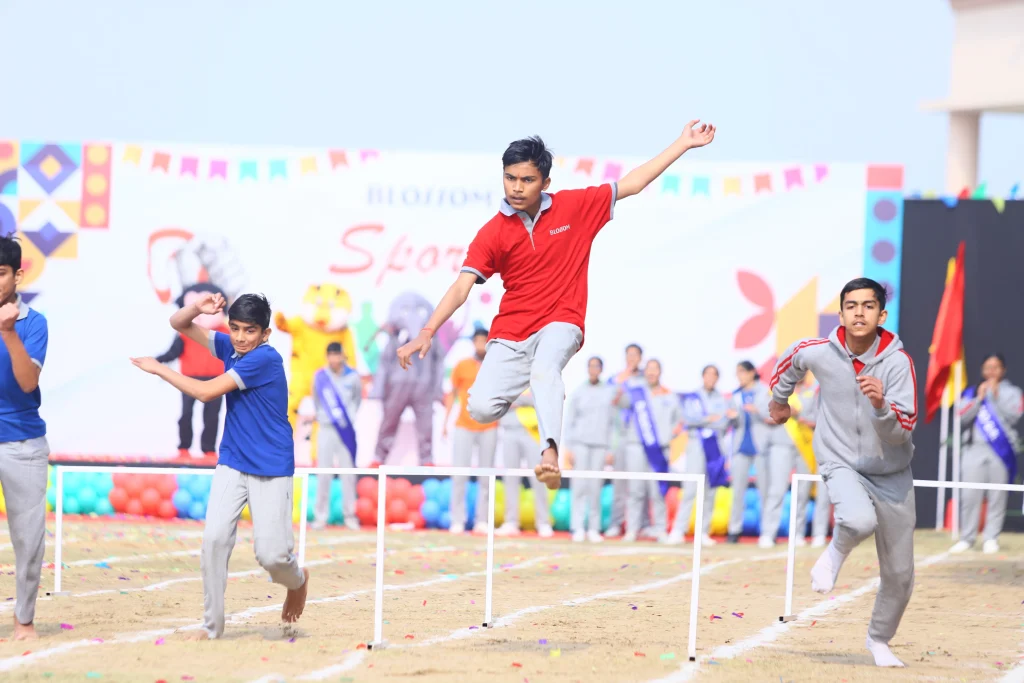
Sports at Blossom Academy include cricket, football, kabaddi, athletics, and indoor games, with an annual sports day in November built around inter-house competitions. Thirteen students from the school have been selected for state level cricket, which is a reasonable indicator that the ground and coaching are being used seriously rather than kept for photographs.
The wider activity calendar covers art and craft with regular competitions and an annual art exhibition, vocal music, instruments and dance, spelling bee contests, and environment club work such as tree plantation and cleanliness drives. Independence Day in August, Teachers’ Day in September, the annual function in December, and Republic Day in January anchor the cultural side of the year.
None of this replaces academics. It does decide whether a child leaves Class 10 able to stand in front of a room and speak, which is a fair test of whether a school has done its job.
Campus, safety, and the practical checks
Safety questions are best settled by a campus visit, though the basics are worth knowing before you go.
The main campus has smart classrooms, a computer lab, science labs, a library stocked with over 10,000 books, a sports ground, and a separate play area. CCTV surveillance runs throughout the campus, entry is controlled, and school transport is available.
Keeping pre-primary children on a separate city campus is a deliberate choice, and a sensible one. Very young children are not sharing corridors, washrooms, or ground space with Class 10 students.
On the teaching side, the school has over 30 teachers with an average of more than 14 years of teaching experience, which speaks to stability. Regular parent teacher meetings are the formal channel for tracking progress, though the office is open Monday to Saturday, 10 AM to 4 PM, for anything urgent.
Results and track record
Blossom Academy has produced district level rankers in the CBSE Class 10 examinations. Recent toppers include Tanya Taneja at 98.6 per cent, placed first in the district, along with Aariv Baghla and Nidhi Jagga, both at 98.4 per cent and placed second in the district.
Top scores tell you what the strongest students achieved. When you visit, ask the second question as well: how the middle of the class performed, and what support is given to students who struggle. A school’s answer to that question is usually more revealing than its topper board.
Why this works for Suratgarh families
Location does a lot of the work here. The main campus sits on Anupgarh Road near the bus stand, which keeps it reachable from most parts of town and from the surrounding villages, and school transport covers the rest. Families in this region often weigh sending a child to Sri Ganganagar or Bikaner for schooling. A local option that runs the same CBSE curriculum removes long daily travel and keeps the child at home.
Access matters too. A parent who can reach the school in fifteen minutes will actually attend the PTM, follow up on a weak subject, and speak to a teacher when something changes at home. That contact is hard to maintain from another city.
Twenty years in one town also means the school’s reputation is not built on advertising. Most families here already know someone whose child studied at Blossom, and that is worth asking about before you decide.
Visiting the school
The most useful thing you can do is walk through the campus during school hours, when classes are running and children are actually in the corridors. Look at a classroom mid lesson, meet the teacher who would take your child, and ask about class strength for the specific section you are considering.
For a campus visit or an admission enquiry for Class 1 to 10, the school can be reached at 72402 08888 or enquiries can also be submitted through the website. Admissions for the 2026 session are currently open.
Frequently asked questions
Which classes does Blossom Academy offer admission for?
Blossom Academy offers admission from LKG through Class 10. Pre-primary classes are held at the city campus, and Class 1 to 10 are taught at the main campus on Anupgarh Road, Manaksar, Suratgarh.
Is Blossom Academy a CBSE school, and is teaching in English?
Yes. Blossom Academy follows the CBSE curriculum and teaches in English medium from LKG to Class 10. Students appear for the CBSE Class 10 board examination.
How many students are there in each class?
The school maintains a teacher to student ratio of approximately 1:25 and has over 30 teachers with an average of more than 14 years of teaching experience. Parent teacher meetings are held regularly through the academic year.
How do I apply for Class 1 to 10 admission at Blossom Academy in Suratgarh?
Parents can call 72402 08888 or submit an enquiry through the school website. The school office is open Monday to Saturday from 10 AM to 4 PM, and campus visits during school hours can be scheduled in advance.