
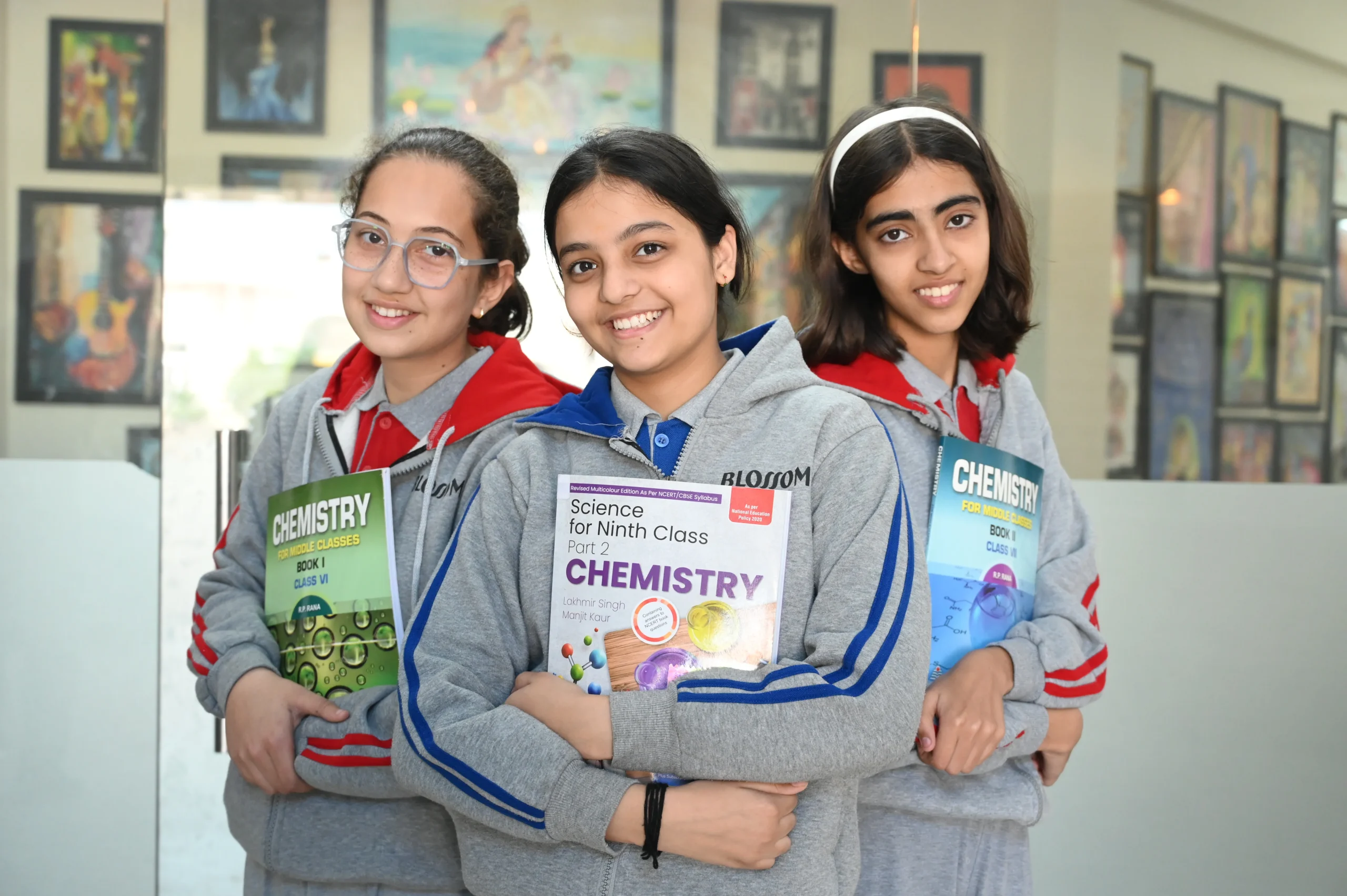
If you are a parent in Suratgarh choosing a school, the English medium vs Hindi medium school question probably comes up at every family discussion. Relatives have opinions, neighbours have opinions, and the child’s comfort matters too. The good news is that there is no single right answer for every family. There is, however, a clear way to think it through, and this guide walks you through it step by step.
Quick answer: English medium schools teach most subjects in English, which helps with higher education, national competitive exams taken in English, and careers beyond the district. Hindi medium schools teach in a language most Rajasthan children already speak at home, which can make early concepts easier. The right choice depends on your child’s age, support at home, and long-term goals.
What “Medium of Instruction” Actually Means
The medium of instruction is the language teachers use to explain lessons, write on the board, set question papers, and expect answers in. It is not the same as the languages a child studies as subjects.
This distinction matters. A child in an English medium CBSE school still studies Hindi as a language subject, often for many years. A child in a Hindi medium school still studies English as a subject. So the real question is not “English or Hindi?” It is “In which language will my child learn maths, science, and social science most effectively?”
English Medium vs Hindi Medium School: The Key Differences
Here is how the two options usually compare for families in Suratgarh and nearby areas:
- Textbooks and teaching: English medium schools use English textbooks for most subjects. Hindi medium schools use Hindi textbooks and explanations.
- Board and curriculum: Most CBSE schools in the region teach in English, while many RBSE (Rajasthan Board) schools teach in Hindi. The board and the medium are separate choices, but they often go together locally.
- Exposure to English: In an English medium school, a child hears, reads, and writes English every day. In a Hindi medium school, English practice is mostly limited to the English period.
- Early comfort: Children who speak Hindi, Rajasthani, or Punjabi at home often find early lessons easier in Hindi.
- Later transitions: College courses in engineering, medicine, management, and law are mostly taught in English, so students from Hindi medium schools sometimes need extra time to adjust.
Neither list is a verdict. Both types of school produce successful students. The difference is in which challenges your child will face, and when.
Benefits of English Medium Education
Easier Access to Higher Education
Most college textbooks, reference material, and online learning resources in science, technology, and commerce are in English. A student who has studied in English since the early years usually moves into these courses without a language gap.
Preparation for Competitive Exams
Major national exams such as JEE Main and NEET can be taken in Hindi as well as English, which is a real option for Hindi medium students. Still, much of the coaching material, reference books, and advanced practice content is in English. Students comfortable in English can use a wider range of resources.
Career Prospects Beyond the District
Many parents in Suratgarh hope their children will have options, whether that means a job in Jaipur, Delhi, or abroad, or building a business here with customers across India. Spoken and written English is useful in interviews, workplace communication, and client dealings.
Confidence in Communication
When English is part of daily school life through class discussions, presentations, and debates, children tend to lose the hesitation many adults still feel when speaking it. That confidence often carries into interviews and group settings later.
When Hindi Medium Makes Sense
Hindi medium schooling is not a “lesser” choice. It can be the better fit in certain situations:
- Your child is starting school late or moving from another school and is not yet comfortable in English.
- Your child has a strong interest in subjects where Hindi resources are rich, such as Hindi literature or state-level services.
- Your family plans a long-term future in Rajasthan, where Hindi is used widely in local government, business, and daily life.
- The nearest English medium options do not actually teach in English and quietly shift to Hindi in class, which gives the child neither language well.
That last point is worth taking seriously. A label on the gate means little if the teaching does not match it. When you visit any school, ask to sit in on a class or speak with current parents.
Common Worries Suratgarh Parents Have
We don’t speak English at home. Will my child struggle?
This is the most common concern, and it is a fair one. Many successful English medium students come from homes where English is not spoken. What helps most is a school that builds English gradually in the early years, teachers who explain patiently, and a home that encourages reading, even in Hindi. Your child does not need perfect English at admission. They need the right support after it.
Does the medium affect board exam marks?
Board results depend far more on understanding concepts, regular practice, and good teaching than on the medium itself. A child who understands science in English will do well in English. A child who memorises without understanding will struggle in either language. [ADD VERIFIED STAT if comparing board results by medium]
What about the local job market?
For many local roles, Hindi is enough. But families often want to keep doors open. English medium schooling, combined with strong Hindi taught as a subject, gives a child the ability to work comfortably in both local and national settings.
What the CBSE Curriculum and NEP 2020 Say About Language
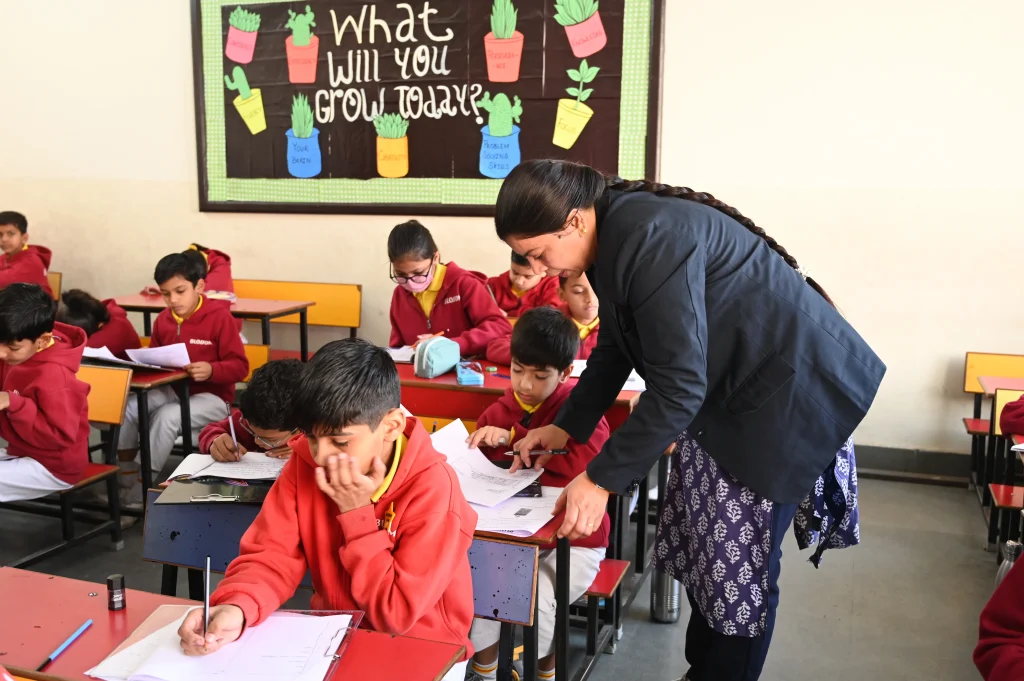
The National Education Policy 2020 recommends that, wherever possible, children learn in their home language or mother tongue at least until Class 5, because mother tongue learning helps young children understand concepts more deeply. In 2025, CBSE also asked its schools to make more use of the child’s home or familiar language in the early years.
What this means in practice is not “English vs Hindi” but bilingual learning. Good CBSE schools use a child’s home language to explain difficult ideas in the early classes while steadily building English. Over time, the child becomes confident in both.
For families, this is reassuring. Choosing an English medium CBSE school does not mean cutting your child off from Hindi. Hindi remains a compulsory language subject through the middle years, and teachers can use it to support understanding when needed. If you want to understand what CBSE status actually guarantees, read our guide on what makes a school CBSE affiliated and why it matters.
A Practical Checklist to Help You Decide
Before you finalise admission, work through these questions as a family:
- What language does your child think in right now? A four-year-old adapts quickly. A ten-year-old switching mediums will need more support.
- What support can you give at home? You do not need to speak English fluently, but you should be able to encourage reading and check homework routines.
- What are your long-term goals for your child’s academic future? Consider whether college, competitive exams, or work outside Rajasthan are likely.
- Is the school’s English medium real? Sit in on a class, look at student notebooks, and talk to parents.
- How does the school help children who find English hard? Ask about remedial support, reading programmes, and how teachers use Hindi to explain concepts.
- Does the school still take Hindi seriously? Your child should read and write Hindi well too.
If most of your answers point towards wider options and your child is young, an English medium school is often the practical choice. If your child is older and struggling with English, a Hindi medium school or a gradual transition may serve them better.
How Blossom Academy Approaches Language
Blossom Academy has been running in Suratgarh since 2004 and follows the CBSE curriculum in English medium from LKG to Class 10. Many of our students come from Hindi, Rajasthani, or Punjabi speaking homes, so English is built step by step, starting at the pre-primary campus. Hindi is taught as a full language subject, and teachers explain difficult ideas in a way children understand.
Programmes like Blossom Speaks give students regular practice in speaking in front of others, which builds confidence in both languages. You can read more about how subjects are taught across classes on our academics page.
The Bottom Line
The English medium vs Hindi medium school decision is less about which language is “better” and more about what your child needs now and where you hope they will go. For most young children in Suratgarh, an English medium CBSE school that respects and uses their home language offers the widest set of options without losing their roots.
Visit a few schools, ask the questions above, and trust what you see in the classroom. If you would like to see how we work, the admissions page explains the process and how to arrange a campus visit.
Frequently Asked Questions
Is English medium better than Hindi medium for my child?
Neither is better for every child. English medium makes college courses, English-language study material and careers outside Rajasthan easier to access. Hindi medium can make early learning easier for children who speak Hindi at home. Look at your child’s age, the support you can give at home, and your long-term goals.
Can my child do well in an English medium school if we speak Hindi at home?
Yes. Many successful English medium students come from Hindi, Rajasthani or Punjabi speaking homes. What matters most is a school that builds English gradually, teachers who explain patiently, and regular reading at home. Children who start in the early classes usually adapt faster than those who switch medium later.
Can students from Hindi medium schools clear JEE and NEET?
Yes. JEE Main and NEET can be taken in Hindi as well as English, so Hindi medium students are not shut out of these exams. However, much of the advanced coaching material and many reference books are in English, so comfort with English gives students access to a wider range of preparation resources.
Do CBSE English medium schools still teach Hindi?
Yes. In CBSE schools, Hindi is usually taught as a language subject through the middle years, and many students continue it up to Class 10. The medium of instruction only decides which language is used for teaching subjects like maths and science. Your child can become confident in both English and Hindi.
What is the right age to start in an English medium school?
The earlier the better, ideally from nursery or LKG. Young children pick up a new language quickly, especially when their home language is used to explain difficult ideas. Children who join in later classes can still adjust well, but they usually need extra reading practice and teacher support in the first year.