
Your child reads the English chapter aloud in class, but at home the book stays closed. Or your child understands English cartoons perfectly yet answers every English question with one word. Many Suratgarh parents notice this gap, especially when English is not the main language at home.
The reassuring part: you do not need perfect English or expensive classes. A few small habits, repeated daily, can improve your child’s English at home far more than an occasional long study session.
Quick answer: To improve your child’s English at home, read together daily, set a short fixed English time, talk through everyday tasks in simple English, play word games, encourage small writing tasks and correct mistakes gently by repeating the right sentence. Consistency matters more than time. Fifteen relaxed minutes a day usually works better than one long weekend session.
Why English Practice at Home Matters
Learning a language needs regular use in real situations, and home offers the most natural chances: meals, chores, bedtime and play. When children use English for things they care about, words stop being something to memorise and become something to use.
Research supports the simplest habit of all. A review published in the Archives of Disease in Childhood found that reading aloud to young children builds language and early literacy skills that help them get ready for school.
A child who makes mistakes freely at home is also more willing to try in class.
Easy English Activities for Kids at Home: 10 Daily Habits
You do not need to start all ten at once. Pick two or three that suit your family, keep them going for a month, then add more.
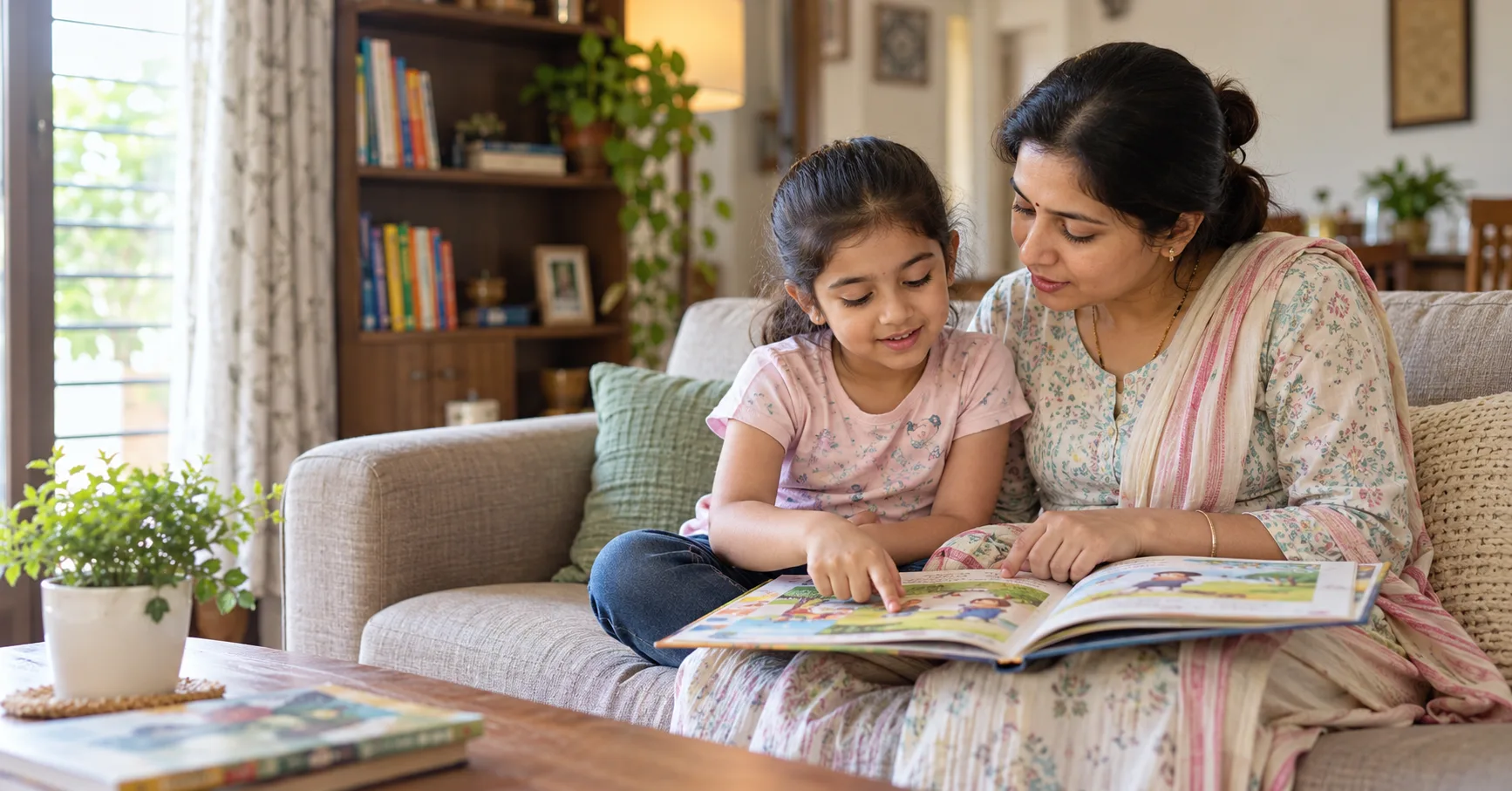
1. Read Together for 10 Minutes Every Day
Pick books slightly below your child’s level so reading feels easy and enjoyable. Young children enjoy picture books, while older children can try story books, magazines or a newspaper’s sports page.
Do not just read the words. Pause and ask, “What do you think happens next?” or “Why is the boy upset?” Questions build understanding, not just reading speed.
Try this: Let your child choose the book twice a week. Choice keeps interest alive.
2. Set a Fixed “English Time” Each Day
Choose a regular 15-minute slot, such as after the evening snack, when the family uses English as much as possible. Hindi words are allowed when someone gets stuck. The goal is practice, not perfection.
Try this: Stick a small note on the fridge that says “English Time: 7:00 to 7:15 PM” so everyone remembers.
3. Label Things Around the House
Write simple English names on paper slips and stick them on everyday objects: door, window, fridge, mirror, clock and cupboard. Children see these words daily and pick them up without effort.
For older children, go a step further. Put a “word of the day” on the mirror with a short example, such as “Curious: The puppy was curious about the new ball.”
4. Talk Through Daily Tasks in Simple English
Describe what you are doing while you do it. “I am washing the vegetables. Now I am cutting the tomatoes. Can you bring me the bowl?” This is how children naturally learn any language: by hearing words linked to real actions.
You can also describe what your child is doing. “You are wearing your blue shoes. You tied the laces yourself!” Short, clear sentences work best.
5. Use Hindi as a Bridge, Not a Barrier
A strong home language, whether Hindi, Rajasthani or Punjabi, often helps a child understand new ideas faster. If your child does not know a word, explain it in Hindi first, then use it in an English sentence.
For example: “Gussa means angry. Can you say, ‘I am angry because my pencil broke’?”
There is no need to ban your home language. If you are still choosing a school medium, our guide on English medium vs Hindi medium schools explains the decision in detail.
6. Make Screen Time Count
Choose English cartoons, nature shows or story programmes suited to your child’s age, and turn on English subtitles so your child links spoken and written words.
Watch together when you can. Afterwards, ask your child to tell you the story in two or three sentences. This turns watching into speaking practice.
Avoid: leaving a child alone with endless videos.
7. Play Word Games as a Family
Games make learning feel like fun. These need no equipment:
- I Spy: “I spy something that starts with B.” Is it a book or a bottle?
- Word chain: Each person says a word that begins with the last letter of the previous word, such as apple, egg, goat, tiger.
- Twenty questions: One person thinks of an animal while others ask yes-or-no questions in English.
- Spell it out: Call out a word during a car ride and let your child spell it.
Spelling games are also good preparation for school events like the Spelling Bee held at Blossom Academy.
8. Encourage Small, Real Writing Tasks
Give your child small, useful writing jobs:
- Write the weekly shopping list.
- Make a birthday card for a cousin.
- Keep a three-line diary each night: one thing I did, one thing I liked and one thing I want to do tomorrow.
- Send a short message to a grandparent.
When writing has a real purpose, children care more about getting it right.
9. Correct Mistakes Gently by Repeating the Right Sentence
If your child says, “Yesterday I goed to the park,” avoid saying “Wrong!” Instead, repeat the sentence correctly in a natural way: “Oh, you went to the park yesterday? What did you do there?”
Your child hears the correct form without feeling embarrassed, and the conversation keeps going. Constant correction makes children stop talking.
10. Learn Alongside Your Child and Stay in Touch with Teachers
If your own English is not strong, turn that into a shared project. Look up new words together in a dictionary app, or ask your child to teach you one word from school each day. Explaining a word helps children remember it.
Also ask the class teacher which chapters are being covered, so home practice matches classwork.
Age-Wise Guide: What to Focus On at Home
| Stage | Classes | Focus at Home |
| Foundation | LKG to UKG | Rhymes, picture books, naming objects and short spoken sentences |
| Discovery | Class 1 to 2 | Reading aloud together, simple sight words, labels and I Spy |
| Growth | Class 3 to 5 | Independent reading, a three-line diary and spelling games |
| Exploration | Class 6 to 8 | Chapter books, newspaper reading and retelling shows in English |
| Excellence | Class 9 to 10 | Varied reading, letter and essay writing and discussing current topics |
Common Mistakes Parents Should Avoid
- Laughing at wrong pronunciation.
- Comparing your child’s English with a sibling or a neighbour’s child.
- Turning every conversation into a grammar test.
- Using English writing as a punishment.
- Expecting fluency within a few weeks.
Language grows slowly and unevenly, so patience pays off.
How School and Home Can Work Together
At Blossom Academy, an English medium CBSE school in Suratgarh since 2004, English practice runs through several programmes from LKG to Class 10:
• Blossom Speaks: weekly sessions of storytelling, public speaking, debate and creative writing.
• Library Club and Reading Champions: reading sessions, library hours and book reviews, supported by a library of over 10,000 books.
• Debate, quiz and elocution: inter-class events that encourage children to think and speak in English.
• Monthly parent-teacher meetings: a regular chance to discuss progress and agree on home practice.
You can read more about these programmes on our Student Life page and Academics page.
Frequently Asked Questions
How can I improve my child’s English at home if I don’t speak English well?
You can still help a lot. Read picture books together, play simple word games, look up new words side by side in a dictionary app and ask your child to teach you words from school. Your encouragement and a steady routine matter more than your own fluency.
How much time should my child spend on English practice daily?
About 15 to 20 minutes a day is enough for most children, as long as it happens regularly. Short, relaxed sessions that mix reading, talking and games work better than one long weekend session.
Will speaking Hindi at home affect my child’s English?
Not if English practice also happens regularly. A strong home language often helps children understand new ideas, which they can then express in English. Use Hindi to explain difficult words, then practise the English sentence together.
How can I improve my child’s English speaking skills?
Give your child daily chances to speak, not just read. Keep a short English time, ask your child to retell stories or cartoon episodes, play twenty questions and correct mistakes by repeating the right sentence. Never laugh at errors, because fear stops children from speaking.
How do I know if my child’s English is improving?
Look for small signs: new words in daily speech, reading with fewer pauses, longer written sentences or full-sentence answers instead of single words. Compare your child with their own progress from a few months ago, not with other children.
Final Thoughts: Small Steps, Every Day
Improving your child’s English at home is not about long lessons or perfect grammar. It is about reading together, talking often and making mistakes feel safe. Pick two ideas from this list and start tonight. One English bedtime story is a good first step.
To see how Blossom Academy builds English skills in class, visit our contact us to arrange a campus visit.